Ad Blocker Detected
Our website is made possible by displaying online advertisements to our visitors. Please consider supporting us by disabling your ad blocker.
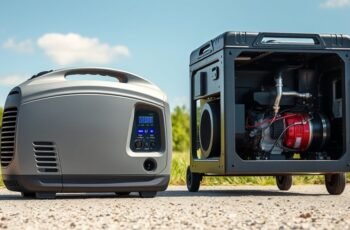
At the crossroads of portable power, understanding the difference between inverter and conventional generators is essential for making an informed choice. While each type offers distinct advantages, their performance, cost, and suitability vary widely depending on application needs. Managing these differences requires a careful analysis of power quality, efficiency, noise levels, and reliability. As we examine these factors, it becomes clear why one may be more appropriate than the other in specific scenarios—details that could influence your decision considerably.
Key Takeaways
- Inverter generators produce cleaner, stable power, ideal for sensitive electronics, while conventional units have fluctuating output risking device damage.
- Inverters are quieter, more fuel-efficient, and portable, making them suitable for camping and noise-sensitive environments.
- Conventional generators are generally more reliable for heavy-duty, prolonged use, but inverter models offer lower maintenance and better fuel efficiency.
- Inverter models tend to have higher initial costs but lower operational and maintenance expenses compared to conventional generators.
- Conventional units often provide longer runtimes per fuel tank and are better suited for demanding, emergency, or heavy-duty applications.
How Do Inverter and Conventional Generators Differ in Power Quality and Performance
While both inverter and conventional generators produce electrical power, they differ considerably regarding power quality and performance. Inverter generators generate cleaner, more stable power with a sine wave output, which reduces voltage fluctuations and harmonic distortion. This results in smoother operation for sensitive electronics. Conventional generators, however, often produce varying waveforms, which can cause issues with delicate devices. Concerning fuel efficiency, inverter models optimize engine speed based on load demand, making them more economical over extended periods. Maintenance requirements also differ; inverter generators tend to have advanced components requiring specific upkeep, but their overall design often leads to longer intervals between service. In contrast, conventional units generally demand more frequent maintenance due to their simpler, less precise regulation systems.
Which Generator Type Is Better for Sensitive Electronics and Camping?
When selecting a generator for sensitive electronics and camping, inverter generators generally outperform conventional models due to their ability to produce stable, clean power. They deliver consistent voltage and frequency, reducing risks of damage to delicate devices. Additionally, inverter generators are more fuel-efficient, making them ideal for extended camping trips where conserving resources is essential. Their design also results in lower maintenance needs, as they operate at variable speeds based on demand, reducing wear and tear.
Inverter generators provide stable, clean power, fuel efficiency, and low maintenance—perfect for sensitive electronics and extended camping trips.
Key considerations include:
- Power stability: Guarantees sensitive electronics operate safely and efficiently.
- Fuel efficiency: Extends runtime, especially crucial for remote camping.
- Maintenance needs: Lower maintenance reduces downtime and costs.
Comparing Cost, Efficiency, and Runtime of Inverter vs Conventional Generators
Comparing the cost, efficiency, and runtime of inverter versus conventional generators reveals significant differences that influence long-term value and operational practicality. Inverter models typically offer higher fuel efficiency, reducing operational costs over time, but often come with higher initial prices. Maintenance costs are generally lower for inverter generators due to fewer moving parts and advanced electronics, enhancing durability. Conventional generators tend to have longer runtimes per fuel tank, but their less efficient engine design results in higher fuel consumption. The table below summarizes these differences:
| Aspect | Inverter Generators | Conventional Generators |
|---|---|---|
| Fuel Efficiency | Higher | Lower |
| Maintenance Costs | Lower | Higher |
| Runtime | Shorter, dependent on fuel tank | Longer, larger fuel tanks |
What Are the Noise Levels and Portability Differences Between the Two?
Inverter generators are generally designed to operate more quietly than conventional models, making them better suited for environments where noise reduction is essential. Their sound insulation features, such as housing design and mufflers, substantially reduce decibel levels, often below 60 dB. This contrasts with conventional generators, which typically produce higher noise levels around 70-80 dB. In terms of portability, inverter models tend to be lighter due to advanced engineering and smaller components, offering a notable weight comparison—often 30-50% lighter. The key differences include:
- Noise Levels: Inverter generators provide quieter operation, ideal for sensitive environments.
- Sound Insulation: Enhanced sound insulation materials minimize noise transmission.
- Weight Comparison: Lighter design facilitates easier transportation and handling.
These factors make inverter generators preferable where mobility and noise control are priorities.
Which Generator Is More Reliable for Emergency Backup and Heavy-Duty Use?
Reliability for emergency backup and heavy-duty applications hinges on a generator’s ability to deliver consistent power under demanding conditions. Conventional generators often excel here due to their robust construction and proven durability, making them suitable for prolonged use. Inverter generators, while more fuel-efficient and quieter, may have limitations in sustained high-load scenarios, potentially impacting dependability. Fuel efficiency is vital during extended outages, and inverters typically consume less fuel, reducing operational costs. However, their more complex components can increase maintenance requirements. Conversely, conventional models tend to have simpler designs, which can translate into easier maintenance but higher fuel consumption. Ultimately, for critical, heavy-duty backup, conventional generators often provide greater reliability, whereas inverters balance efficiency and portability but may require more frequent service under heavy loads.
Frequently Asked Questions
How Long Do Inverter and Conventional Generators Typically Last With Regular Use?
We find inverter generators last around 2,000-3,000 hours, thanks to their fuel efficiency and lower noise levels, while conventional generators often reach 1,500-2,500 hours. Proper maintenance extends their operational lifespan considerably.
What Maintenance Differences Exist Between Inverter and Conventional Generators?
We find inverter generators require less maintenance due to their fuel efficiency and quieter operation, reducing wear on components, whereas conventional generators often need more frequent checks and oil changes to manage higher noise levels and fuel consumption.
Can Inverter Generators Handle Heavy-Duty or Industrial Applications?
We believe inverter generators excel in industrial capacity and power stability, making them suitable for demanding applications where consistent energy is vital. They handle moderate loads well but may require supplementary units for extensive heavy-duty tasks.
Are There Environmental Impacts Associated With Each Generator Type?
Both inverter and conventional generators impact the environment through emissions and noise pollution; inverter models typically offer better emission reduction and quieter operation, making them more environmentally friendly, especially for prolonged use and sensitive environments.
Which Generator Type Is Preferable for Renewable Energy Integration?
We prefer inverters for renewable energy integration, as their solar compatibility and precise grid synchronization support efficient, stable power delivery, making them superior for seamless integration with solar systems and advanced grid management.
Conclusion
In choosing between inverter and conventional generators, we see clear trade-offs in cost, performance, and reliability. Do you prioritize clean, quiet power for sensitive electronics or robust durability for heavy-duty tasks? By understanding these differences, you can make an informed decision tailored to your specific needs. Ultimately, the right generator aligns with your power demands, efficiency goals, and environmental considerations—ensuring you’re prepared, whether for camping, emergencies, or demanding workloads.