Ad Blocker Detected
Our website is made possible by displaying online advertisements to our visitors. Please consider supporting us by disabling your ad blocker.
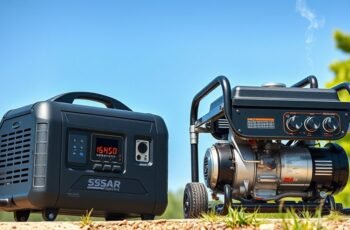
When deciding between a portable power station and a generator, your choice hinges on more than just price. Each offers distinct advantages and drawbacks depending on your specific needs, whether for outdoor adventures or emergency backup. Understanding how they operate, their capacities, and their environmental impact can help you make an informed decision. But which option truly aligns with your lifestyle and expectations? Let’s explore the key differences to help you find the best fit.
Which Power Source Fits Your Outdoor or Emergency Needs?
When deciding between a portable power station and a generator for your outdoor or emergency needs, it’s important to consider how you’ll use the power source. Think about the devices you want to run—small electronics, appliances, or heavy-duty equipment.
If you need quiet operation, portability, and easy charging, a portable power station is ideal. They’re lightweight, produce no fumes, and are simple to operate.
On the other hand, if you require high wattage for larger appliances or longer runtime, a generator might suit you better. Generators can run longer on fuel, making them suitable for extended outages or large outdoor jobs.
Your choice depends on whether you prioritize portability and convenience or raw power and endurance.
How Do Portable Power Stations and Generators Work?
Portable power stations and generators generate electricity through different mechanisms to meet your power needs.
A portable power station uses a built-in battery that stores energy, which is then converted into usable AC or DC power via an inverter. You recharge it by plugging it into an outlet or solar panel, making it quiet and emission-free.
In contrast, a generator produces electricity through an internal combustion engine that turns a rotor inside a stator, generating electrical current through electromagnetic induction. Fuel like gasoline or propane powers the engine, which creates continuous power as long as fuel is available.
While power stations rely on stored energy and are ideal for silent, portable use, generators produce electricity on-demand but tend to be noisier and emit fumes during operation.
How Much Power Do You Really Need? Comparing Capacity and Output
Understanding how much power you need is key to choosing between a portable power station and a generator. First, list the devices you’ll run, noting their wattage. For example, a laptop typically uses 50-100 watts, while a refrigerator might need 600-800 watts. Add these together to determine your total power requirement.
Portable power stations usually have capacities ranging from 200 to 2,000 watt-hours, suitable for small electronics and basic appliances.
Generators, on the other hand, offer continuous output from 1,000 to over 10,000 watts, ideal for larger loads.
Consider your power needs not just now but in future scenarios. If you only need to charge devices and run a few essentials, a portable power station could suffice.
For whole-house backup or high-demand equipment, a generator will be more appropriate.
Which Is Easier to Use and Carry? Portability and Convenience
While both portable power stations and generators are designed to provide electricity away from main power sources, their ease of use and portability vary significantly.
Portable power stations are compact, lightweight, and simple to operate—often just requiring you to press a button. They usually have built-in handles or wheels, making them easy to carry or transport.
Generators, on the other hand, tend to be bulkier and heavier, requiring more effort to move. They often involve fueling and starting procedures, which can be more complicated and time-consuming.
If convenience and ease of carrying are your priorities, a portable power station offers a clear advantage. It’s quick to set up, simple to operate, and easy to pack up and take with you wherever you go.
How Much Do They Cost, and What’s Their Maintenance?
Cost is a key factor to consider when choosing between a portable power station and a generator, as prices can vary widely depending on features and capacity.
Portable power stations tend to be more affordable upfront, with prices generally ranging from a few hundred to around a thousand dollars, depending on battery capacity and features.
Generators, especially gas-powered ones, typically cost more initially, often from $500 to several thousand dollars for larger models.
Maintenance costs also differ: power stations require minimal upkeep—just occasional charging and battery care—while generators need regular oil changes, fuel refills, and inspections, which can add to ongoing expenses.
Consider your budget and how much maintenance effort you’re willing to invest to determine the best choice for your needs.
Are Power Stations or Generators Better for the Environment and Noise?
When comparing power stations and generators in terms of environmental impact and noise, power stations generally come out ahead. They produce zero emissions during operation, making them much cleaner for the environment.
Unlike traditional gas-powered generators, they don’t emit carbon monoxide, nitrogen oxides, or particulate matter, which can harm ecosystems and air quality.
Additionally, power stations operate quietly, often producing minimal noise, which makes them suitable for use in quiet environments like campsites or residential areas.
Generators, on the other hand, rely on combustion engines that generate significant noise and release pollutants into the air.
If reducing your environmental footprint and minimizing noise are priorities, a portable power station is the better choice for cleaner, quieter power.
How to Choose Between a Portable Power Station and a Generator
Choosing between a portable power station and a generator depends on your specific needs and priorities.
If you need quiet, emissions-free power for camping or emergencies, a portable power station is ideal. It’s lightweight, easy to carry, and requires minimal maintenance.
However, if you need to run high-wattage appliances or power multiple devices for extended periods, a generator’s larger capacity and fuel options make it more suitable.
Consider how often you’ll need power—occasional use favors a power station, while frequent or heavy-duty use leans toward a generator.
Also, think about noise levels, portability, and fuel availability.
Your decision hinges on balancing power needs, convenience, and environmental considerations to choose the best option for your situation.
Conclusion
Choosing between a portable power station and a generator depends on your specific needs. If you want quiet, emissions-free power for small devices or outdoor adventures, a power station is ideal. But for larger appliances or prolonged use, a generator offers more capacity. Consider your budget, portability, and environmental concerns to make the best choice. Assess your power needs carefully, and you’ll find the perfect solution for your outdoor or emergency situations.